
Comparing UK and US NBA Betting Markets
 Available in US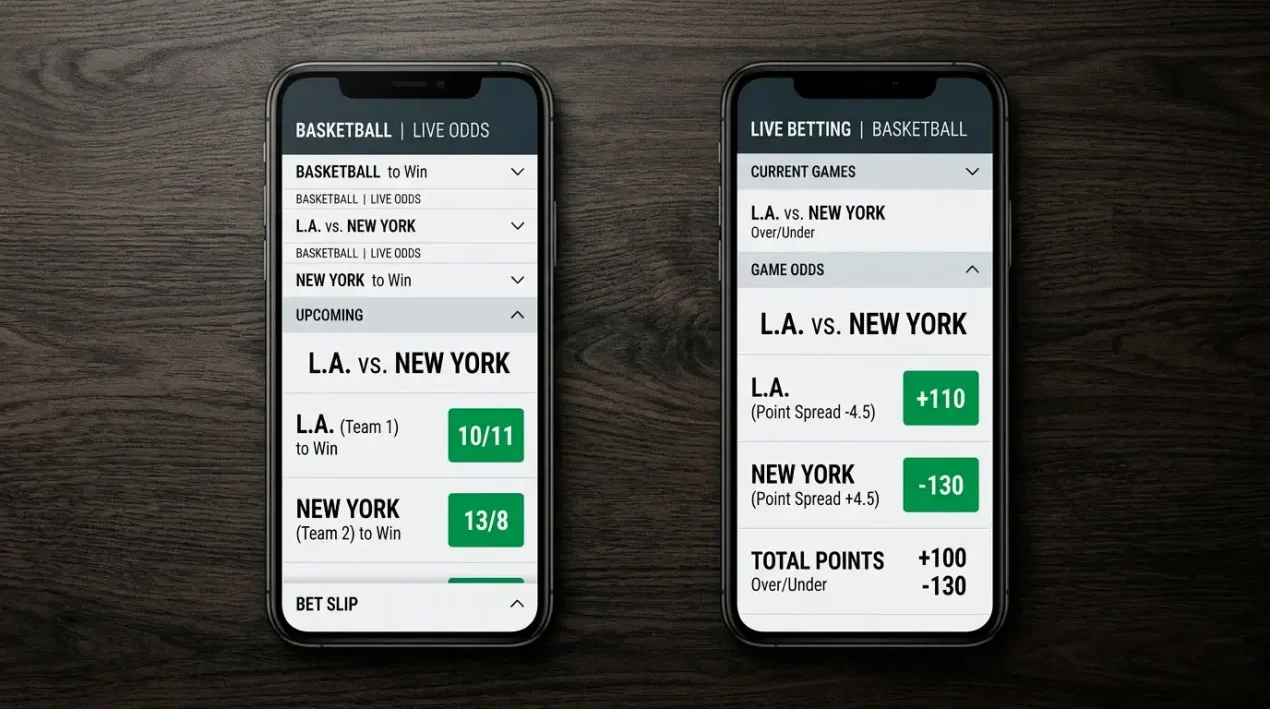
American legal sportsbooks processed 165.58 billion dollars in total handle during 2025, generating 16.80 billion in gross gaming revenue. The UK sports betting market, while mature, operates on a different scale — roughly 2.48 billion pounds in annual gross gaming revenue across all sports. These are not just different numbers. They reflect different regulatory philosophies, different market structures, and different consumer experiences that every UK NBA bettor should understand.
Comparing Centralised UKGC Rules to State-by-State US Regulations
The most fundamental difference is who sets the rules. The UK has a single national regulator — the Gambling Commission — that licenses and oversees all legal gambling activity. One set of rules, one licensing authority, one framework that applies whether you are in London, Edinburgh, or Cardiff. If a bookmaker holds a UKGC licence, it can serve customers anywhere in the country.
The United States has no equivalent national body. Since the Supreme Court struck down PASPA in 2018, each state has been free to legalise and regulate sports betting independently. The result is a patchwork of 30-plus regulatory regimes, each with different tax rates, different licensing requirements, different market rules, and different consumer protection standards. US states collected 3.71 billion dollars in gambling taxes in 2025 — a 32.4% increase over the prior year — but the rates vary dramatically, from single-digit percentages in Nevada to over 50% in some newly legalised states.
US Representative Paul Tonko captured the structural problem when he wrote that the exclusively state-based regulatory approach is “fundamentally flawed” and will continue to put both sporting integrity and public health at risk. The UK avoided this problem by design. Centralised regulation means consistent consumer protection, consistent market standards, and consistent responsible gambling requirements across every operator. As a UK bettor, you benefit from that consistency even if you never think about it.
The revenue figures tell the market-size story. US sportsbook revenue reached 16.96 billion dollars in 2025, growing at 22.8% year on year. That growth is partly organic and partly a function of new states legalising. The UK market is growing more modestly because it has been legal and mature for decades — the low-hanging fruit of first-time bettors was picked long ago.
Odds Formats, Margins, and Tax on Winnings
Walk into any UK bookmaker’s NBA section and the odds are displayed in fractional or decimal format. Cross the Atlantic and everything flips to American odds — plus and minus numbers that express the same probabilities in a format most UK bettors find initially confusing. A line of -150 means you need to stake 150 dollars to win 100. A line of +130 means a 100-dollar stake returns 130 in profit. The conversion is mechanical but the presentation creates a genuine cognitive barrier for UK punters exploring US-oriented coverage.
Margins are broadly comparable between the two markets on major NBA lines — spreads and totals typically carry a vig of 4-5% on both sides of the Atlantic. Where the UK market is sometimes tighter is on moneylines, because UK bookmakers compete fiercely on headline markets and use moneyline pricing as a visible benchmark that attracts customers.
Tax on winnings is the starkest difference. In the UK, punters pay no tax on gambling winnings. Zero. The tax burden falls entirely on the operator through the point-of-consumption duty, which the bookmaker pays on their UK-generated gross gambling yield. In the United States, gambling winnings are taxable income. Federal tax applies at rates up to 37%, and many states impose their own additional tax. A UK punter who wins a hundred pounds on an NBA spread bet keeps a hundred pounds. An American bettor in the same position might keep 65-75 dollars after federal and state taxes. Over a lifetime of NBA betting, that difference is enormous.
Market Depth: Why US Books Offer More NBA Props
If you have ever browsed an American sportsbook’s NBA offering, the sheer volume of markets is striking. A single regular-season game might list 300 or more individual betting options — player props on every statistical category, alternative spreads in half-point increments from minus 15 to plus 15, quarter lines, half-time lines, team totals, margin-of-victory bands, and dozens of exotic combinations. UK bookmakers typically offer 50 to 100 markets per game, which is substantial but noticeably less.
The depth gap exists for two reasons. First, the US market is larger. More betting volume means more liquidity, which allows bookmakers to price niche markets with confidence rather than offering them with wide margins to compensate for thin action. Second, US operators compete on product breadth because they cannot compete meaningfully on odds — American odds margins are relatively standardised. UK bookmakers compete more on price and less on range, which produces a different product mix.
For UK NBA bettors, the practical impact is that certain market types — particularly exotic player prop combinations and alternative game lines — are either unavailable or priced with wider margins than their US equivalents. This is gradually changing as NBA betting volume in the UK grows and operators expand their basketball product in response, but the gap remains significant for bettors who want granular market access.
The flip side is that UK bookmakers offer features that US operators often do not. Bet builder and same game parlay tools are more polished at most UK operators. Cash-out functionality is more widely available and more consistently offered on NBA markets. And the promotional ecosystem — welcome offers, enhanced odds, early payout features — is more varied in the UK because operators have been competing for decades in a mature, legal market. If you want to understand how the global NBA betting market is structured and where the UK sits within it, the differences in depth and features tell you as much as the headline revenue numbers.
Do UK punters pay tax on NBA betting winnings?
No. In the UK, gambling winnings are not subject to income tax or capital gains tax. The tax burden falls on the operator through the point-of-consumption duty, not on the customer. This is one of the most significant structural advantages of betting from the UK compared to the United States, where gambling winnings are taxable income.
Why do US sportsbooks offer more NBA markets than UK bookmakers?
US operators benefit from higher NBA betting volume, which creates enough liquidity to price niche markets profitably. They also compete on product breadth because odds margins are relatively standardised in the US market. UK bookmakers compete more on price and features, offering fewer markets per game but often with tighter margins and better cash-out functionality.
This material was created by the COURTSIDE team.
Related posts

The Under-30 Surge Driving NBA Betting in Britain

Why 76% of Young UK Bettors Already Bet on Mobile