
NBA Betting Online in the UK: Markets and Sportsbooks
 Available in US
The Growth of NBA Betting Options at UK Sportsbooks
Three years ago, I placed a same game parlay on a Tuesday night Celtics-Bucks clash and watched it land at 2 a.m. on my sofa in London. That bet was worth about forty quid. The fact that I could make it at all — legally, instantly, on my phone, through a UKGC-licensed bookmaker — felt unremarkable. It shouldn't have. A decade earlier, NBA betting in Britain was a footnote buried under football accumulators. Now it's one of the fastest-expanding verticals in the UK sportsbook landscape, and the numbers back that up with force.
The global basketball betting market hit $8.7 billion in 2024 and is projected to reach $18.4 billion by 2033, growing at a compound annual rate of 8.7%. NBA wagering alone accounts for roughly 60% of that total. Those aren't projections built on hype. They reflect a structural shift: more access, more data, more markets, and — critically for anyone reading this from the UK — more reasons to pay attention.
What changed? Start with visibility. NBA viewership in the UK surged 40% from 2019, driven almost entirely by fans under 30. Basketball now ranks as the sixth most popular sport among 18-to-24-year-olds in Britain, a cohort that grew up watching highlights on social media before they ever saw a full game on television. Sky Sports locked in an 11-year deal with the NBA starting from the 2025-26 season, delivering over 100 live games per year to UK screens. That kind of broadcast infrastructure doesn't just create fans. It creates bettors.
NBA's Senior Vice President for Europe, Benjamin Morel, put it plainly when discussing UK ticket demand: selling out so quickly is testament to the popularity of players and teams, and further evidence of an ever-growing appetite for the NBA in the UK. That appetite has only accelerated since. The 2026 London Game — Grizzlies versus Magic at The O2 — became the most-watched NBA Global Game in UK history.
I've spent nine years analysing NBA lines, tracking schedule fatigue, modelling player props, and watching the UK market evolve from an afterthought into a genuine opportunity. This guide is the resource I wish I'd had when I started. It covers every bet type available to UK punters, explains odds formats you'll actually encounter, walks through how to evaluate bookmakers, introduces the strategic principles that separate break-even bettors from profitable ones, and doesn't shy away from the regulatory reality or the risks involved. Every claim is backed by data. Every recommendation is grounded in experience. No fluff, no promotional dressing — just the mechanics of NBA wagering in Britain, laid out for anyone willing to learn them.
Nine Years of NBA Betting in the UK, Distilled
- The global basketball betting market reached $8.7 billion in 2024, with the NBA accounting for 60% of all basketball wagering — and UK viewership has surged 40% since 2019, fuelled by fans under 30.
- Three core bet types — moneyline, point spread, and over/under totals — cover the vast majority of NBA wagering volume. Master these before exploring props, parlays, or futures.
- UK regulatory changes in 2025-2026 introduced a statutory gambling levy, a 10x wagering requirement cap on bonuses, and tighter marketing restrictions, reshaping how operators compete and how bettors are protected.
- Strategy beats intuition over an 82-game season: fixed unit sizing, schedule-aware game selection, and consistent record-keeping separate profitable bettors from recreational ones.
- Responsible gambling tools — deposit limits, session timers, GAMSTOP self-exclusion — are not optional extras. With 2.7% of UK adults meeting problem gambling criteria and only 3.4% seeking help, proactive safeguards matter.
The NBA Betting Market in the UK: Numbers Behind the Growth
I remember a conversation with a bookmaker's trading desk in 2018 where I was told, almost apologetically, that NBA markets "weren't worth the overhead" for UK operators. They offered moneylines and maybe a total, nothing more. Fast forward to today and that same operator lists 150-plus markets per NBA game on a regular Tuesday night. Something shifted — and the data tells us exactly what.
~GBP 2.48 Billion
Annual gross gambling revenue from sports betting in the UK as of early 2026
47%
Proportion of UK adults who participated in some form of gambling in 2025
76%
Young bettors (18-24) who place wagers via mobile phone in the UK
The UK sports betting market generates approximately GBP 2.48 billion ($3.3 billion) in gross gambling revenue each year. That figure covers everything from Premier League match betting to horse racing, but basketball's share is growing faster than almost any other vertical. Across the globe, basketball represents 15-18% of all sports betting activity, and among certain operators the share climbs past 30%. In Britain specifically, 10% of the population now actively participates in online sports wagering, and 12% of adults placed a sports bet within any given four-week window in 2025.
What makes the NBA's growth in the UK distinct from, say, football's established dominance is the demographic engine behind it. The Gambling Commission's own survey data shows that 47% of British adults engaged in some form of gambling in 2025. But within that population, the under-30 cohort is disproportionately drawn to basketball. The NBA ranks sixth in sports engagement among 18-to-24-year-olds — ahead of rugby league, golf, and boxing. These aren't casual viewers; they're the generation that checks injury reports on Twitter at breakfast and has a prop bet placed before their morning commute. Andrew Rhodes, CEO of the UK Gambling Commission, has described the Gambling Survey for Great Britain as a key building block of the evidence base that helps government, industry, and partners understand gambling behaviour and its consequences. That evidence increasingly points to basketball as a growth category.
The broadcast infrastructure I mentioned in the introduction deserves a closer look here because media access and betting volume are inseparable. Sky Sports' 11-year contract delivers 100-plus live NBA games per season to UK households. Prime Video adds another 86 regular-season games along with NBA Cup fixtures, a Conference Finals series, and the NBA Finals in six of the deal's eleven years. Combine those two platforms and a British fan can watch NBA basketball nearly every day of the season without a VPN or a dodgy stream. That matters because live viewing feeds live betting — and live/in-play wagering now accounts for 62.35% of all online sports betting revenue globally. Mobile platforms handle over 70% of basketball betting volume worldwide, and in the UK, 95% of online bets are placed from home, with 76% of young adults using their phones.
NBA viewership in the UK has grown 40% since 2019 — and basketball now ranks as the sixth most popular sport among British 18-to-24-year-olds, the fastest-growing betting demographic in the country.

The live betting connection is self-reinforcing. More broadcast coverage means more moments bettors can react to in real time: a star player picking up early foul trouble, a blowout that tightens in the third quarter, a bench unit outperforming expectations. Each of those moments is a market. And the user base engaging with those markets is expanding at 12% annually for live basketball wagering specifically. That's not a fluke or a marketing stat. It's what happens when a sport with natural scoring volatility, frequent lead changes, and global media saturation meets a mature regulatory environment with established mobile infrastructure. The UK has all of those ingredients in place, and the market trajectory reflects it.
Every NBA Bet Type Available to UK Punters
When I first started betting on the NBA in Britain, I had three options: pick the winner, guess the total, or walk away. The market has matured beyond recognition since then. A typical UK bookmaker now offers dozens of markets per game, and understanding the differences between them isn't optional — it's the foundation everything else rests on. Let me walk you through each one, starting with the simplest and building toward the more complex.
The three core bet types — moneyline, point spread, and totals — cover roughly 80% of NBA wagering volume. NBA betting accounts for approximately 60% of the entire global basketball wagering market, so these aren't niche instruments. They're the backbone of a multi-billion-dollar ecosystem, and every UK bettor needs to understand how they work before exploring anything else.
| Feature | Moneyline | Point Spread | Over/Under (Totals) |
|---|---|---|---|
| What you predict | Which team wins | Winning margin relative to a set line | Combined score above or below a number |
| Overtime included? | Yes | Yes | Yes |
| Typical odds range (decimal) | 1.10 - 4.50 | 1.85 - 1.95 | 1.85 - 1.95 |
| Best for beginners? | Yes — simplest structure | Moderate — requires margin thinking | Moderate — requires pace/scoring knowledge |
| Key analytical edge | Identifying mispriced favourites/underdogs | Margin-of-victory modelling, ATS records | Pace data, injury impact on scoring output |
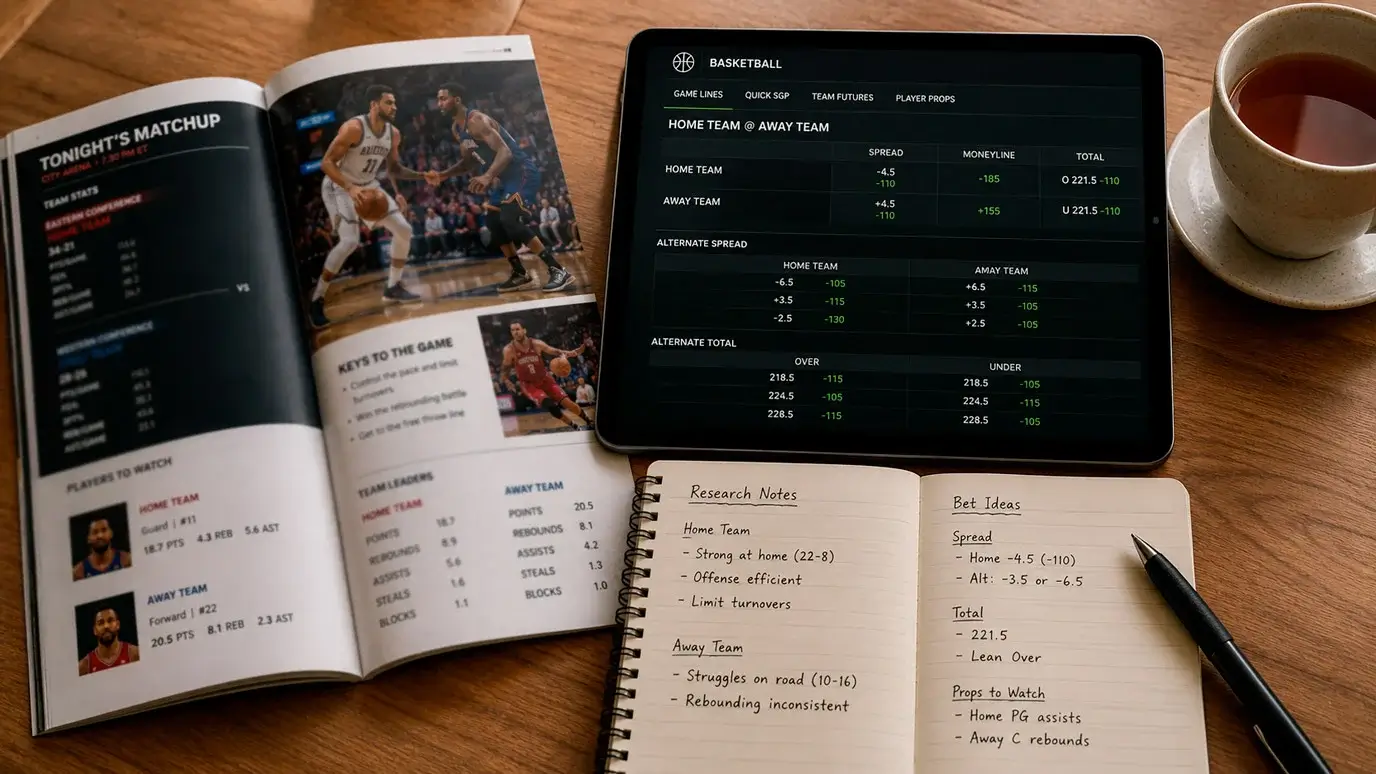
Moneyline Bets
A moneyline bet is the purest wager in basketball: pick the team that wins the game, full stop. No margins, no totals, no complications. If you back the underdog at 3.50 decimal odds and they win by a single point in triple overtime, you collect exactly as if they'd won by thirty. Overtime counts, which is an important distinction from some other bet types.
Moneyline Payout Calculation
Suppose you place GBP 20 on Team A at decimal odds of 2.40.
Potential return = Stake x Odds = GBP 20 x 2.40 = GBP 48.00
Profit = Return - Stake = GBP 48.00 - GBP 20.00 = GBP 28.00
If Team A wins by any margin, including overtime, you receive GBP 48.00 back (your GBP 20 stake plus GBP 28 profit).
Moneyline is where most beginners should start, and I say that from experience. My first NBA bet was a moneyline wager on the Spurs in 2017, and the simplicity of "they win, I win" gave me space to learn how odds worked without getting tangled in spreads and margins. The trade-off is value: heavy favourites carry short prices (1.15, 1.20), so you're risking a lot to win a little. Underdogs offer better returns but win less often. The skill lies in finding games where the bookmaker has mispriced one side — and understanding when a moneyline offers better risk-adjusted returns than a spread, which depends on the expected margin of victory and the odds available on each market.
Point Spread Bets
ATS (Against the Spread) — a record of how often a team has covered the point spread set by bookmakers, regardless of whether they won or lost the game outright.
Point spread betting — also called handicap betting in UK terminology — levels the playing field by assigning a points advantage or disadvantage to each team. If Team A is favoured by 6.5 points, they need to win by 7 or more for a spread bet on them to pay out. The underdog, Team B, can lose by up to 6 points and still "cover" the spread.
Point Spread Payout Calculation
Team A is listed at -6.5 points with decimal odds of 1.91. You stake GBP 25.
If Team A wins 112-104 (margin of 8 points), they've covered the 6.5-point spread.
Return = GBP 25 x 1.91 = GBP 47.75
Profit = GBP 47.75 - GBP 25.00 = GBP 22.75
If Team A wins 110-105 (margin of 5), the spread is not covered. Your GBP 25 stake is lost.
Spread betting is where the NBA betting market really deepens. Moneyline tells you who won; the spread tells you whether the margin matched expectations. I find that most bettors who move past the beginner stage gravitate toward spreads because the odds on either side are nearly identical (typically 1.85-1.95), which means you're not penalised as heavily for backing favourites. The analytical edge comes from modelling how teams perform against the spread over time — their ATS record — which is a different skill from simply predicting winners. Overtime counts in spread bets, just like moneylines. The full mechanics of how spreads are built, how to buy and sell points, and the most common mistakes I see UK bettors make are all covered in the spread betting explained article.
Courtside tool
The Margin Bridge
Translate a point spread into a fair moneyline, then see which of the two routes actually pays more at the prices in front of you.
Spread is the better route — +8.2% per £1 staked, against +6.7% on the moneyline.
Crossover at 7.9 pts: below that projected margin the moneyline pays better, above it the spread. Assumes the listed spread is the market's honest expected margin and that NBA margins are near-normal, with volatility scaling off the game total. Informational only — 18+.
Over/Under (Totals)
A totals bet asks one question: will the combined final score of both teams land above or below a number set by the bookmaker? A line of 224.5 means you're betting on whether the game produces 225 or more points (over) or 224 or fewer (under). The half-point eliminates pushes, so there's always a result.
Totals Payout Calculation
The total is set at 219.5. You stake GBP 15 on the over at decimal odds of 1.90.
Final score: 114-110, combined 224 points. The over hits.
Return = GBP 15 x 1.90 = GBP 28.50
Profit = GBP 28.50 - GBP 15.00 = GBP 13.50
Totals betting is where pace data, injury reports, and even altitude come into play. A game between two top-five pace teams will look entirely different from a defensive grind. I've found that totals markets are often slower to adjust to late-breaking injury news than spreads or moneylines, which occasionally creates value windows for punters who are paying attention. Like spreads and moneylines, overtime scoring counts toward the final total. The analytical framework for approaching totals — including which metrics matter most and when to bet over versus under — is something I break down in the live betting guide, where real-time totals shifts create some of the sharpest in-play edges.
Props, Parlays, and Futures at a Glance
Player Props
Bets on individual player statistics — points scored, rebounds, assists, three-pointers made, and combination markets like points + rebounds + assists (PRA). Props are the fastest-growing NBA market segment. They reward research into matchups, minutes, and usage rates. A full breakdown of every prop market and how to evaluate them is in the player props guide.
Parlays and Accumulators
A parlay (called an accumulator or "acca" in UK betting language) combines multiple selections into a single bet. All legs must win for the bet to pay out, but the combined odds multiply. A three-leg parlay at 1.90 per leg returns roughly 6.86x your stake if all three hit. The appeal is obvious; the risk is mathematical. Bookmaker margins compound with each added leg, eroding your expected value. Parlays work as a strategic tool, not a lottery ticket.
Futures
Futures are long-horizon bets placed on outcomes that won't be decided for weeks or months: which team wins the championship, who takes the MVP award, season win totals, conference winners. The advantage of futures is that odds shift significantly over time, so early conviction can lock in value that evaporates by mid-season. Timing and patience define this market. The full strategy for when and how to approach NBA futures is in the futures betting guide.
These three categories — props, parlays, and futures — extend the NBA betting experience well beyond the core moneyline/spread/totals trio. Each rewards a different type of analysis, and each carries its own risk profile. My advice for anyone new to NBA wagering: master the three core types first, then layer in props and futures as your understanding of the game deepens. Parlays should be the last tool you reach for, not the first.
Reading NBA Odds: Fractional, Decimal, and American Formats
The first time I tried to compare NBA odds across three different bookmakers, I ended up staring at three different formats on three different screens and genuinely couldn't tell which price was best. Fractional odds on one site, decimal on another, American on a third. It took me an embarrassingly long time to realise they were all saying the same thing in different mathematical languages. Let me save you that confusion.
| Scenario | Fractional (UK traditional) | Decimal (European standard) | American (US format) |
|---|---|---|---|
| Slight favourite | 4/5 | 1.80 | -125 |
| Even money | 1/1 | 2.00 | +100 |
| Moderate underdog | 5/2 | 3.50 | +250 |
| Heavy favourite | 1/5 | 1.20 | -500 |
| Long-shot underdog | 10/1 | 11.00 | +1000 |
Fractional odds are the traditional UK format. You'll see them written as 5/2, 4/1, or 8/13. The first number tells you your profit relative to the second number. At 5/2, a GBP 2 stake returns GBP 5 profit (plus your GBP 2 back). At 8/13, you'd need to stake GBP 13 to earn GBP 8 profit. They're intuitive once you've used them a few times, but they become cumbersome for quick mental calculations when comparing across multiple markets.
Decimal odds are simpler for computation, which is why I switched to them years ago and never looked back. The number represents your total return per GBP 1 staked. Odds of 2.40 mean a GBP 1 bet returns GBP 2.40 (GBP 1.40 profit). Odds of 1.50 mean GBP 1 returns GBP 1.50 (GBP 0.50 profit). The key advantage: you can instantly see implied probability. Divide 1 by the decimal odds. 1 / 2.40 = 0.417, or 41.7% implied probability. That calculation is essential for finding value, because it tells you how often a selection needs to win for the bet to break even.
Quick Conversion Formulas
Fractional to Decimal: divide the first number by the second, then add 1. So 5/2 becomes (5 / 2) + 1 = 3.50.
Decimal to Fractional: subtract 1, then express as a fraction. 3.50 becomes 2.50, which is 5/2.
Decimal to Implied Probability: divide 1 by the decimal odds. 1 / 1.80 = 55.6%.
Remember: bookmaker odds include a margin (the "overround"), so implied probabilities for both sides of a market will sum to more than 100%.

American odds appear on US-focused platforms and in cross-Atlantic content. Positive numbers (+250) show how much profit a GBP 100 bet would generate. Negative numbers (-125) show how much you'd need to stake to earn GBP 100 profit. Most UK bookmakers let you toggle between formats in your account settings. My recommendation: use decimal for analysis and comparison, switch to fractional if that's what feels natural for placing bets, and learn to read American odds well enough to interpret US-sourced analysis without converting every number.
The practical takeaway is this: format doesn't change value. A bet priced at 5/2, 3.50, and +250 is identical in every meaningful way. What changes your returns is finding the best price across bookmakers for the same selection, and that process becomes significantly faster when you're working in a single format. I do all my pre-game analysis in decimal, compare prices in decimal, and only glance at fractional when I'm confirming the slip on a UK bookmaker's site.
How to Choose an NBA Bookmaker Licensed in the UK
I've held accounts with over a dozen UK-licensed bookmakers over the years, and the difference between a good NBA betting experience and a frustrating one comes down to a handful of concrete factors — none of which are the size of the welcome bonus. That's marketing. What follows is operational reality.
UKGC Licence Is Non-Negotiable
Every bookmaker operating legally in the UK must hold a licence from the UK Gambling Commission. This isn't a rubber stamp — it means the operator is subject to regular audits, mandatory responsible gambling tools, ring-fenced player funds, and enforceable dispute resolution. If a sportsbook doesn't display its UKGC licence number (usually in the footer), walk away. Full stop.
Beyond the licence, here's what actually matters for NBA betting specifically. First, market depth. A bookmaker that offers moneyline, spread, and totals for every NBA game is meeting the bare minimum. What separates useful platforms from adequate ones is the range of player props, quarter/half markets, same game parlay options, and alternative lines (spreads at -4.5 instead of -5.5, for example). I want at least 80 markets per game during the regular season, and I want them available early — ideally 24 hours before tip-off.
Second, mobile performance. Over 70% of global basketball betting volume runs through mobile platforms, and the overwhelming majority of young UK bettors wager on their phones. That means the mobile app or mobile site isn't an afterthought — it's the primary interface. Test it during a live game. Does it lag? Do odds update in real time? Can you navigate from NBA game to player props within two taps? If the answer to any of those is no, the platform isn't built for NBA live betting.
Third, odds quality. Bookmakers set their own margins, and the difference between 1.87 and 1.93 on the same spread matters more than most casual bettors realise. Over hundreds of bets, a few percentage points of margin difference compound into real money. I check at least three prices before placing any NBA wager, and I'd recommend the same habit to anyone serious about long-term profitability.
Before You Open an NBA Betting Account
- Verify the bookmaker holds an active UK Gambling Commission licence (check the UKGC register, not just the site footer)
- Confirm NBA market depth: player props, quarter/half lines, alternative spreads, same game parlays
- Test the mobile platform during a live NBA game for speed, stability, and navigation
- Compare odds on three recent NBA games against at least two other bookmakers
- Check in-play betting availability: do live NBA markets stay open throughout all four quarters?
- Review the cash-out and partial cash-out options for NBA bets
- Confirm responsible gambling tools: deposit limits, session timers, reality checks, and self-exclusion access
Fourth, in-play reliability. Live NBA betting demands real-time data feeds. I've been burned by platforms that suspend markets for 30-60 seconds after every scoring run, effectively locking you out of the moments where value appears. The best UK bookmakers keep NBA live markets open for the vast majority of game time, with brief suspensions only around free throws and end-of-quarter buzzers.
Fifth, responsible gambling infrastructure. This isn't a box-ticking exercise. Deposit limits, loss limits, session time reminders, and easy access to self-exclusion through GAMSTOP are baseline requirements. I'll cover these tools in detail later in this guide, but they should influence your choice of bookmaker from the start — not as an afterthought once you've already signed up.
Building Your First NBA Betting Strategy
I lost money for my entire first NBA season. Not because I picked the wrong teams — I actually hit about 53% on moneylines — but because I had no system. I chased losses, doubled stakes after wins, ignored rest patterns, and treated every game as equally important. The turning point wasn't a magic formula. It was realising that discipline is the strategy, and everything else is tactics.
NBA Commissioner Adam Silver himself has described the tension at the heart of this sport's relationship with betting. Small, seemingly inconsequential outcomes within a game can be manipulated, he noted, and there's nothing more important than the integrity of the competition. That observation cuts both ways for bettors. The granularity of NBA data — play-by-play, lineup tracking, rest patterns — creates genuine analytical edges. But those same edges vanish if you don't have a framework for exploiting them consistently.
Do
- Set a fixed unit size (1-3% of your bankroll per bet) before the season starts
- Track every bet in a spreadsheet: date, game, bet type, odds, stake, result, running profit/loss
- Check injury reports and lineup confirmations within 90 minutes of tip-off
- Focus on 2-3 bet types you understand deeply rather than scattering across every market
- Review your results monthly against closing lines, not just win/loss outcomes
Don't
- Increase stakes after losses to "get back to even" — that's the fastest path to a blown bankroll
- Bet on every game of the night — an 82-game season provides plenty of selective opportunities
- Ignore schedule context: back-to-back games, long road trips, and time-zone changes affect performance
- Treat parlays as your primary bet type — the compounding margin erodes expected value with each leg
- Chase steam moves without understanding why the line shifted
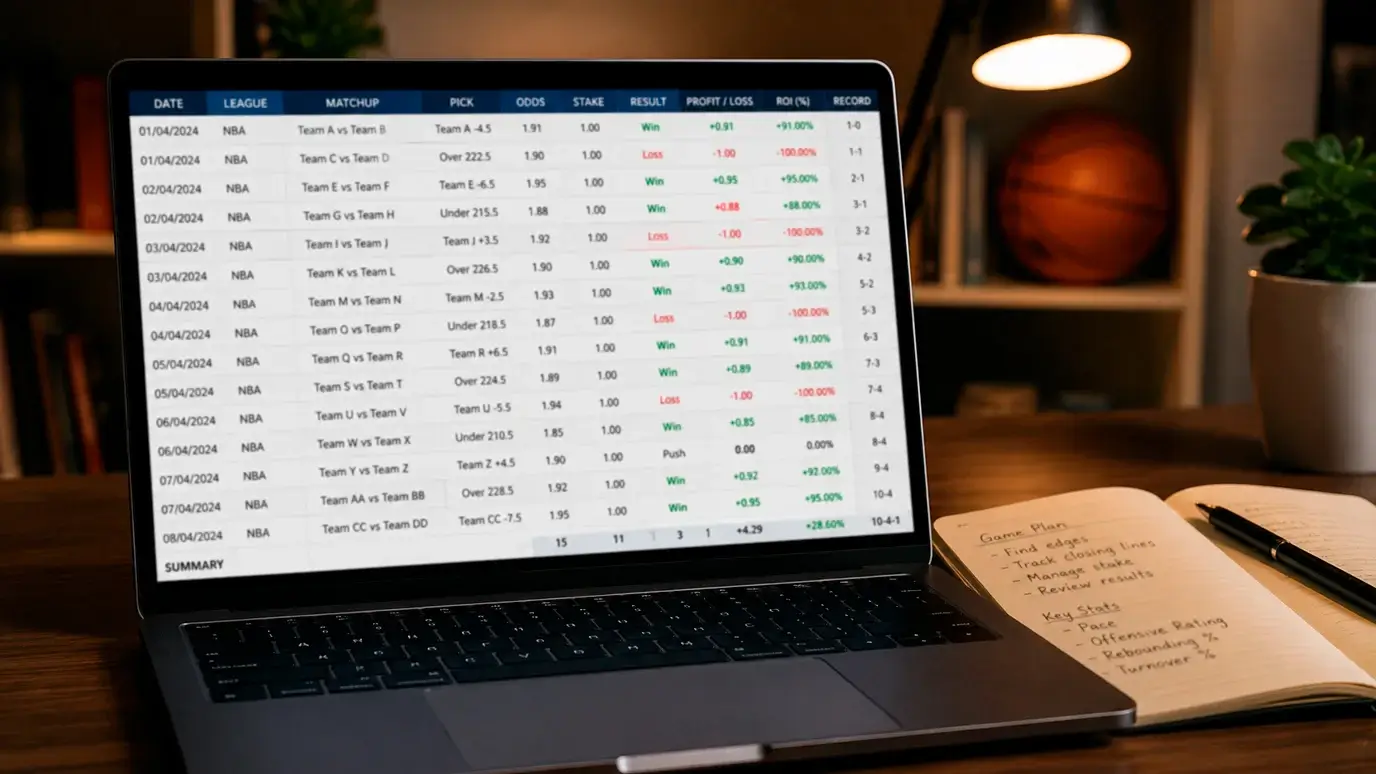
Here's what a basic strategic framework looks like in practice. Start with game selection. Not every NBA game offers value; most don't. I typically identify 3-5 games per week where my pre-game analysis disagrees with the closing line by a meaningful margin. Those are my bets. Everything else, I watch for entertainment.
Next, consider schedule context. The NBA's 82-game regular season is a marathon, and teams don't perform uniformly across it. A team playing the second night of a back-to-back on the road, in a different time zone, against a rested opponent is at a measurable disadvantage. These situations aren't secrets — bookmakers adjust lines for them — but the adjustments aren't always sufficient. Globally, basketball represents 15-18% of sports betting activity, and the sheer volume of NBA games means that schedule-driven inefficiencies appear more frequently than in sports with shorter seasons.
Then there's the question of what data to prioritise. Live/in-play betting on basketball grows at 12% annually in terms of user base, which tells you where the market's attention is flowing. But pre-game analysis still drives the sharpest edges. Offensive and defensive ratings, pace metrics, true shooting percentages, and net rating differentials — these are the numbers that predict outcomes more reliably than win-loss records or recent form. I go into much deeper detail on building a data-backed NBA betting strategy, including specific models and record-keeping systems, in the dedicated strategy guide.
Strategy determines how you bet. Regulation determines where and under what rules. The UK's regulatory landscape changed significantly in 2025 — and the changes directly affect how NBA bettors operate.
UK Gambling Regulation and What It Means for NBA Bettors
April 2025 didn't just bring a new NBA playoff bracket. It brought three regulatory changes that reshaped the operating environment for every UK bettor, and most people I talk to about NBA wagering still haven't registered what happened. Let me lay it out.
The biggest structural shift is the statutory gambling levy. Since April 2025, every licensed operator in the UK pays a mandatory percentage of their gross gambling yield into a fund that finances research, prevention, and treatment of gambling harm. This replaced the old voluntary contribution system, which — let's be direct — was chronically underfunded because operators could largely set their own terms. The new levy is legally enforceable, and it means the financial infrastructure for gambling harm support is more robust than it has ever been in Britain.
The Statutory Gambling Levy
Introduced in April 2025, the statutory levy requires all UK-licensed gambling operators to contribute a fixed percentage of their gross gambling yield toward funding gambling research, education, and treatment. This replaced the previous voluntary system and is enforced through the Gambling Act 2005 framework.
The second change hits closer to the betslip. From 19 January 2026, the Gambling Commission imposed a cap on wagering requirements for bonuses at a maximum of 10x. That means if a bookmaker offers you a GBP 20 free bet, they can require you to wager a total of GBP 200 before withdrawing any winnings — but no more. The same set of rules banned mixed product promotions, preventing operators from tying casino bonuses to sports betting offers and vice versa. For NBA bettors specifically, this simplifies the promotional landscape. You can evaluate a free bet offer on its own terms without worrying about being funnelled into slot wagering to unlock it.
Stake Limits for Online Products
Since 9 April 2025, online slot stakes in the UK are capped at GBP 5 per spin for bettors aged 25 and over, and GBP 2 for those aged 18-24. While these limits apply to slots rather than sports betting directly, they reflect the Gambling Commission's broader direction: tighter consumer protections, especially for younger users. Sports-specific stake limits remain under discussion.
What does all this mean practically? Three things. First, the playing field between operators is more level. Operators can no longer differentiate primarily through aggressive bonus structures with opaque small print; they compete on odds quality, market depth, and user experience instead. Second, the responsible gambling infrastructure is better funded. The statutory levy ensures that treatment and prevention services receive consistent financing, not discretionary handouts. Third, the regulatory direction is clear: the UK is moving toward tighter consumer protections, and bettors who understand those protections are better positioned to use them.
The Gambling Commission reports that 2.7% of the UK adult population meets the criteria for serious problem gambling. That number sounds small until you consider the population of Britain. It represents hundreds of thousands of people, and the regulatory changes I've described are a direct response to the harm they experience. As NBA bettors, we operate within this framework, and understanding it isn't just about compliance — it's about recognising that the market we participate in is shaped by public health considerations as much as by supply and demand.
Responsible Gambling: Tools and Warning Signs
I want to be honest about something. In my second year of NBA betting, I went through a stretch where I was placing bets at 3 a.m. on West Coast games not because I'd identified value, but because I couldn't sleep after a losing night and wanted to "fix" it before morning. That's not strategy. That's a warning sign. I caught it early, set a session time limit, and stepped back for a week. Not everyone catches it, and the data on that reality is sobering.
The Gambling Commission's most recent survey found that 2.7% of UK adults meet the criteria for serious problem gambling. That's roughly 1.4 million people. Even more striking: only 3.4% of those individuals seek help. The gap between harm and treatment is enormous, and it's why every responsible gambling tool available to you matters — not as a regulatory checkbox, but as a practical safeguard.
Dr. Nasir Naqvi, who directs the Gambling Disorders Clinic at Columbia University, described the trajectory plainly: he doesn't want to overstate the problem, but it's a looming public health crisis. That assessment applies globally, and the UK is not immune.
If You or Someone You Know Needs Support
GamCare: 0808 8020 133 (free, 24/7). National Gambling Helpline offering confidential support.
GAMSTOP: self-exclusion from all UKGC-licensed online gambling sites for 6 months, 1 year, or 5 years.
GambleAware: gambleaware.org for information, tools, and treatment referrals.

Every UKGC-licensed bookmaker must provide deposit limits (daily, weekly, monthly), loss limits, session time reminders, and cooling-off periods. These aren't hidden in settings menus — they're required to be accessible. Use them proactively. I set a weekly deposit limit at the start of every NBA season, and I haven't changed it mid-season in four years. The point isn't to restrict yourself arbitrarily; it's to make the decision about how much you're willing to risk when you're thinking clearly, not during a losing streak at midnight.
Do
- Set deposit and loss limits before you start betting each season
- Use session time reminders — NBA games start late in the UK, and fatigue impairs judgement
- Take a week off if you notice yourself betting to recover losses rather than to exploit value
- Separate your betting bankroll from your everyday finances
Don't
- Chase losses by increasing stake sizes after a bad night
- Bet under the influence of alcohol or when sleep-deprived
- View gambling as a source of income — it's entertainment with analytical edges, not a salary
- Ignore early warning signs: irritability after losses, secrecy about betting activity, betting with money earmarked for bills
GAMSTOP self-exclusion is the most decisive tool available. It locks you out of every UKGC-licensed online gambling site for a period you choose: six months, one year, or five years. It's free, it's irreversible for the chosen period, and it works across the entire regulated UK market. If you ever feel that your relationship with NBA betting — or any form of gambling — has moved from recreational to compulsive, GAMSTOP exists for exactly that reason. No guide about NBA betting is complete without saying so directly.
Frequently Asked Questions
Is NBA betting legal in the UK?
Yes. NBA betting is fully legal in the UK when conducted through operators licensed by the UK Gambling Commission (UKGC). The Gambling Act 2005 established the regulatory framework, and any bookmaker offering NBA markets to UK residents must hold a valid remote operating licence. You can verify any operator's licence status through the UKGC's public register. Unlicensed operators have no legal standing in the UK, and using them offers you none of the consumer protections — deposit limits, dispute resolution, ring-fenced funds — that regulated sites provide.
What types of bets can I place on NBA games?
UK bookmakers offer a wide range of NBA bet types. The three core markets are moneyline (picking the outright winner), point spread (betting on the winning margin relative to a handicap line), and over/under totals (whether the combined score exceeds a set number). Beyond those, you'll find player props (individual player statistics like points, rebounds, and assists), same game parlays (combining multiple selections from a single game), futures (championship winner, MVP, season win totals), quarter and half lines, and live in-play markets that update throughout the game. A well-stocked UK bookmaker typically offers 100-plus markets per NBA game.
Does overtime count in NBA bets?
For the three main bet types — moneyline, point spread, and totals — overtime counts. If a game goes to OT, the final score including all overtime periods determines whether your bet wins or loses. The exception is quarter and half bets, which settle based on the score at the end of the specific period you wagered on. A fourth-quarter bet, for instance, covers only the fourth quarter's scoring; overtime points are excluded. Always check your bookmaker's specific settlement rules, as some operators handle edge cases (double overtime, triple overtime) with slight variations.
How do NBA odds work in the UK?
UK bookmakers display NBA odds in fractional format (5/2, 4/1) by default, though most allow you to switch to decimal (3.50, 5.00) or American (+250, -125) in your account settings. The odds represent the bookmaker's assessment of each outcome's probability, with a built-in margin (the "overround") that ensures the house profits over time. To find value, convert odds to implied probability: for decimal odds, divide 1 by the odds (1 / 2.40 = 41.7%). If your own analysis suggests the true probability is higher than the implied probability, the bet offers positive expected value. I recommend working in decimal format for analysis and comparisons — it makes the maths significantly faster.
What are NBA player prop bets?
Player props are bets on individual player statistics within a game rather than on the game's outcome. Common NBA prop markets include points scored, rebounds, assists, three-pointers made, steals, blocks, and combination markets like points + rebounds + assists (PRA). You bet on whether a player will go over or under a line set by the bookmaker — for example, whether a guard will score over or under 24.5 points. Props reward research into matchups, minutes distribution, pace, and usage rates. They're the fastest-growing segment of NBA betting and are covered in depth in the player props guide.
When is the best time to bet on NBA games?
Timing depends on your strategy and the bet type. For game-day markets (moneyline, spread, totals), lines typically sharpen as tip-off approaches because more information enters the market — injury confirmations, lineup announcements, late money from sharp bettors. Early lines (released 24-48 hours before a game) can offer value if you have information the market hasn't fully priced in yet. For futures, the best value often appears before the season starts or around inflection points like the trade deadline and All-Star break, when new information reshapes title probabilities. For live betting, the highest-value moments tend to come during runs — when one team goes on a 12-0 scoring burst and the live odds overcorrect.
What is the best NBA betting strategy for beginners?
Start simple. Focus on moneyline bets for your first few weeks to learn how odds, stakes, and payouts interact without the added complexity of spreads or props. Set a fixed bankroll — an amount you can afford to lose entirely — and risk no more than 1-3% of it per bet. Track every wager in a spreadsheet. Once you're comfortable with moneylines, add point spreads and totals. Before placing any bet, check injury reports, rest patterns (back-to-back games matter), and compare odds across at least two bookmakers. Avoid parlays until you have a clear understanding of how compounding margins reduce expected value. Strategy isn't about finding secrets; it's about consistent, informed decision-making over a long season.
Related posts
The Under-30 Surge Driving NBA Betting in Britain

Why 76% of Young UK Bettors Already Bet on Mobile