
Fractional vs Decimal NBA Betting Odds Explained
 Available in US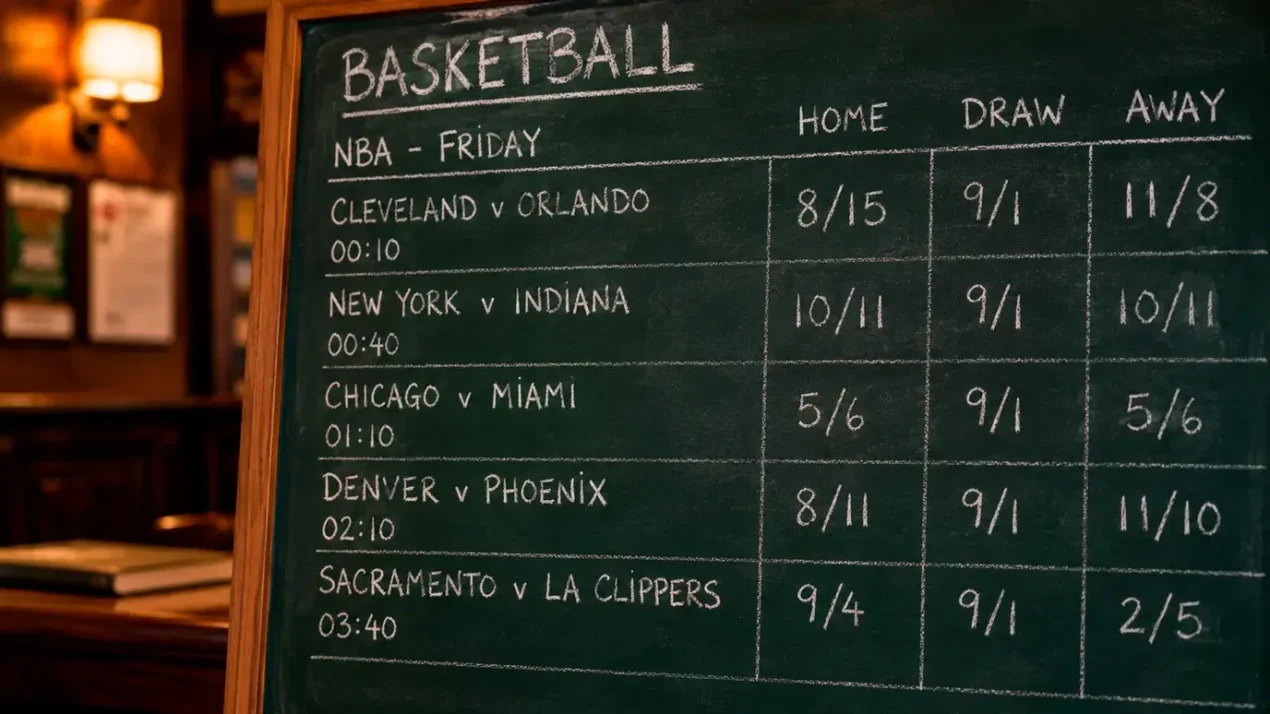
Fractional Odds vs Decimal: Formatting UK Betting Lines
Fractional odds express your profit relative to your stake. At 5/1, you win five pounds for every pound staked. At 4/5, you win four pounds for every five staked. The numerator is profit, the denominator is the stake required. It is the oldest and most familiar format for UK bettors, rooted in horse racing tradition and still the default at most high-street bookmakers.
The strength of fractional odds is their intuitive readability for simple prices. Evens is 1/1 — you double your money. 2/1 is clear: three pounds back for every one risked. The format falls apart when the odds get complex. What is 11/8? You win eleven pounds for every eight staked, which works out to 1.375 times your stake in profit. But doing that calculation in your head while comparing it against 13/10 at another bookmaker (1.3 times profit) is slow enough to cost you time — and in live NBA betting, time is money.
Fractional odds also create an illusion of precision. At 5/2, the implied probability is 28.6%. At 11/4, it is 26.7%. The two-percentage-point difference matters, but it is hidden behind fractions that feel similar. Bettors who stick exclusively to fractional format often make selection decisions based on how the fraction “looks” rather than on the underlying probability it represents. I have watched friends dismiss a 5/2 selection as too risky while happily backing a 2/1 choice, not realising the probability gap is only six percentage points.
Decimal Odds: The European Standard
Decimal odds express the total return per unit staked, including the original stake. At 2.50, a one-pound bet returns two pounds fifty — one pound fifty in profit plus the original pound. At 1.80, the return is one pound eighty. The calculation is a single multiplication: stake times odds equals total return.
The advantage for NBA betting is speed and comparability. When you are checking odds across four UK bookmakers, seeing 1.87, 1.91, 1.85, and 1.90 gives you an instant visual ranking. The best price jumps out. In fractional format, the same prices might display as 87/100, 10/11, 17/20, and 9/10 — four different-looking fractions that require individual conversion to compare. If you are line shopping before a 1:30am NBA tip-off and need to place a bet before the line moves, the format that lets you compare fastest wins.
Decimal odds also make implied probability calculation trivial. Divide one by the decimal odds: 1 / 1.91 = 52.4%. No fraction manipulation, no rounding ambiguity. Every decimal price maps directly to a probability, and that directness is why most professional and semi-professional bettors — including everyone I know who bets on NBA seriously — use decimal as their primary format.
The one area where decimal can mislead beginners is the inclusion of the stake in the quoted number. At odds of 1.10, a casual bettor might think they are getting a meaningful return, but the profit is only ten pence per pound. The fractional equivalent — 1/10 — makes the meagre profit more immediately apparent. For heavy favourites, fractional format can actually be clearer about the risk-reward profile.
Converting Between Formats and Calculating Payouts
The conversions are mechanical but worth memorising for the prices you encounter most often. Fractional to decimal: divide the numerator by the denominator and add one. At 5/4: 5 / 4 = 1.25, plus 1 = 2.25. Decimal to fractional: subtract one from the decimal odds and express as a fraction. At 2.25: 2.25 – 1 = 1.25, which is 5/4.
American odds, which you will encounter when reading US NBA coverage, add a third layer. Positive American odds (e.g. +150) tell you how much profit you win on a 100-unit stake. Negative odds (e.g. -160) tell you how much you need to stake to win 100. To convert +150 to decimal: (150 / 100) + 1 = 2.50. To convert -160: (100 / 160) + 1 = 1.625. If you consume NBA betting analysis from US podcasts or websites, being able to convert American odds to your preferred format on the fly lets you evaluate their selections against the prices available at your UK bookmaker.
Adam Woodhead, a senior analyst at The Investors Centre, noted that two policy moves are pushing the spread-bet tax advantage wider through 2026 — the Capital Gains Tax annual exempt amount has fallen 76% from 12,300 pounds to 3,000 pounds in two years. While this observation relates to spread betting in the financial sense rather than sports betting, it underscores a broader point: the financial framework around UK betting is shifting, and understanding the numbers — whether they are odds, probabilities, or tax thresholds — is the foundation of informed participation.
My recommendation is straightforward: switch your UK bookmaker’s display to decimal and keep it there. Every NBA odds comparison, every implied probability calculation, and every payout estimate becomes faster and more accurate. The fractional format served its purpose in the era of chalkboards and paper slips. For digital, cross-platform NBA betting, decimal is the format built for the way you actually use odds.
If you are working through implied probability for the first time, the moneyline betting guide walks through the full calculation with NBA-specific examples, including how to strip the bookmaker’s vig from the quoted price to reveal the true implied probability.
Which odds format is better for NBA betting in the UK?
Decimal odds are better for most NBA betting purposes because they allow faster comparison across bookmakers, simpler implied-probability calculation, and more intuitive payout estimation. Most UK bookmakers let you switch between fractional and decimal in your account settings. Professional and semi-professional bettors overwhelmingly prefer decimal.
How do I convert fractional NBA odds to decimal?
Divide the numerator by the denominator, then add one. For example, 5/4 becomes 5 divided by 4 = 1.25, plus 1 = 2.25 in decimal. To convert back from decimal to fractional, subtract one and express the result as a fraction: 2.25 minus 1 = 1.25, which is 5/4.
This material was created by the COURTSIDE team.
Related posts

The Under-30 Surge Driving NBA Betting in Britain

Why 76% of Young UK Bettors Already Bet on Mobile