
NBA Public Betting Percentages and Consensus Data
 Available in US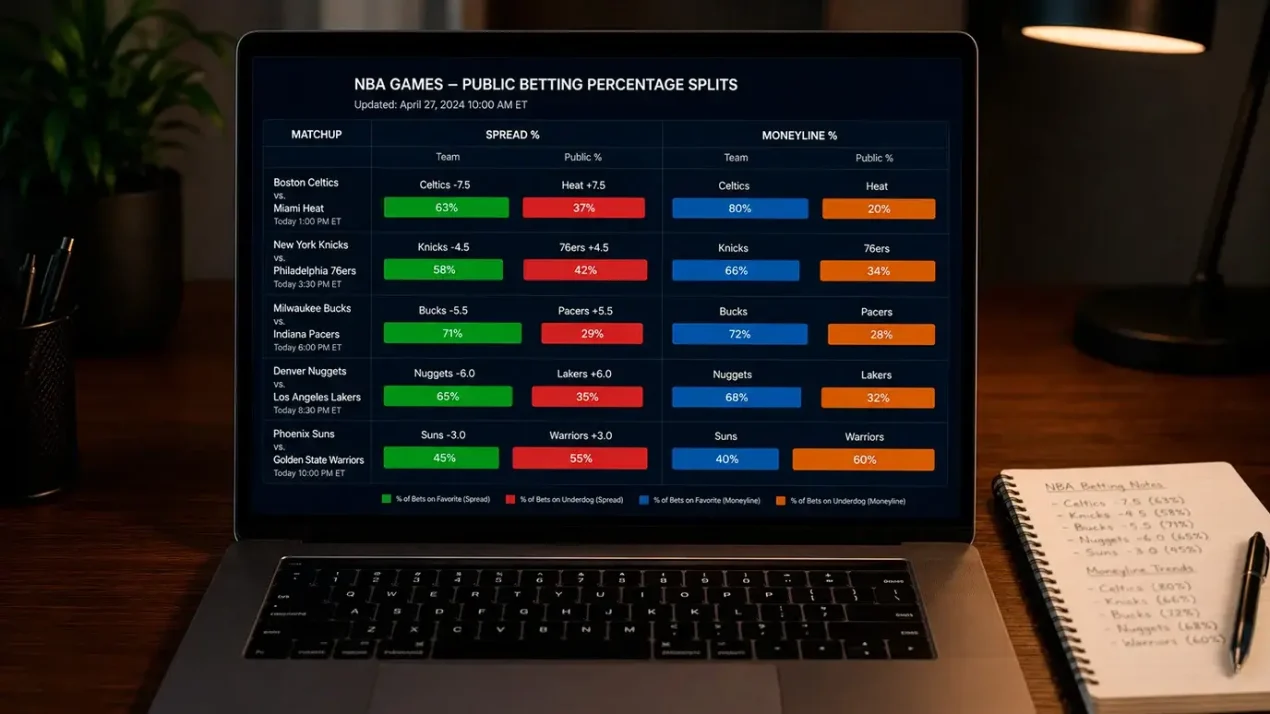
American legal sportsbooks handled over 165 billion dollars in wagers during 2025, and the two largest operators — FanDuel and DraftKings — controlled roughly 75% of the market between them. That concentration means the consensus data generated by those platforms carries real weight. While the UK market is structured differently, the underlying principle transfers: understanding who is betting on what, and how the market responds, is a genuine analytical tool — not a magic wand, but a tool.
Analyzing Consensus Data and Public NBA Betting Percentages
Public betting percentages are compiled from the bet-slip data of participating sportsbooks. When a site reports that 72% of bets are on Team A, it means 72% of the individual wagers placed through that platform or group of platforms are on Team A. This is a count of tickets, not a count of money. And that distinction is everything.
A thousand casual bettors might each place ten pounds on the Lakers, generating ten thousand pounds of volume split across a thousand tickets. A single sharp bettor might place five thousand pounds on the opposing side — one ticket. The ticket percentage would show 99.9% of bets on the Lakers. The money percentage would show a very different picture: roughly 67% on the Lakers and 33% on the opposition. The ticket count screams consensus. The money count whispers dissent. When you see public betting percentages, always check whether the source is reporting tickets, money, or both. If they only report tickets, you are seeing the crowd’s opinion without knowing whether anyone with meaningful capital agrees.
Most free consensus tools available to UK punters report ticket percentages from US-facing sportsbooks. A handful of premium services also report money percentages. The free data is still useful, but treat it as one input rather than the whole picture. Michael Holley, a sports reporter and professor at Boston University, put it bluntly when discussing the gap between public perception and market reality in sports betting: the people most vocal about their bets are not the ones who will acknowledge when they have a problem — or when they are wrong.
Fading the Public: When Contrarian Betting Works
The contrarian approach — betting against the public when consensus reaches extreme levels — has genuine historical support in NBA markets. The logic is simple. When the public heavily favours one side, the sportsbook needs to attract money to the other side to balance its exposure. It does this by making the less popular side more attractive, either by moving the line or offering slightly better odds. Over time, the unpopular side benefits from this structural adjustment.
In my experience, the contrarian signal becomes meaningful when public betting exceeds 70% on one side. Below that threshold, the split is not extreme enough to create consistent line value on the other side. Above 70%, and particularly above 75%, the bookmaker’s need to balance action becomes a tailwind for the contrarian position.
The strongest contrarian spots combine three elements: heavy public ticket percentage on one side, line movement in the opposite direction, and a fundamental reason for the sharp money to disagree. That third element is what separates a contrarian bet from a contrarian hope. Fading the public just because they are the public is not a strategy — it is a contrarian bias, which is just as irrational as following the crowd. The public is wrong often enough to create opportunities, but they are also right often enough to punish blind fading.
I keep a running log of every game where the public exceeded 75% on one side. Over the last three seasons, the contrarian side covered the spread at a rate of approximately 53-54% in those spots. That is a meaningful edge after accounting for the vig, but it requires discipline — you are betting against the popular narrative night after night, and there will be stretches where the public is right and your contrarian picks lose four or five in a row. If you cannot stomach that variance, this approach is not for you.
Why Consensus Numbers Alone Are Not a Strategy
The biggest mistake I see UK punters make with public betting data is treating it as a standalone decision-making tool. They check the percentages, pick the contrarian side, and move on. No research into the game itself. No consideration of injuries, rest, matchups, or pace. Just “the public is on the Lakers, so I am on the Celtics.” That is lazy contrarianism, and it loses money at the same rate as lazy consensus-following.
Consensus data works best as a filter, not a generator. Use it to narrow your slate of games to those where the public is creating a potential distortion, and then apply your own analysis to determine whether the contrarian side has merit. If the public is 78% on the Bucks and the line has moved towards the Bucks, that is the market agreeing with the public — the sharp money is on the same side. Fading that game is fighting both the public and the sharps, which is a terrible position to be in.
Conversely, if the public is 78% on the Bucks and the line has moved a full point towards the opponent, something interesting is happening. Money — serious money, not recreational wagers — is disagreeing with the crowd. That is the game to research further. Check the injury report. Look at the schedule context. Examine recent head-to-head performance. If your analysis supports the contrarian position, you have a bet with structural and analytical backing. If your analysis supports the Bucks despite the line movement, pass on the game entirely. Not every signal needs to be acted on.
The integration of public betting data into a broader NBA betting strategy is what makes it valuable. On its own, it is a single data point. Combined with line movement analysis, schedule awareness, and your own game research, it becomes a truly useful piece of the puzzle. Treat it accordingly.
Practical Steps for UK Punters Using Consensus Data
Access to public betting percentages is less seamless for UK-based bettors than for their American counterparts. The major US consensus trackers report data from platforms that do not operate in the UK market, so the percentages reflect American betting behaviour rather than British. That said, the NBA is a global product with global odds markets, and the trends in public sentiment are largely consistent across geographies. When 75% of American bettors are on the Lakers, the UK market is typically skewed in the same direction.
Use the free consensus data as a starting point. Bookmark two or three reputable trackers and check them as part of your pre-bet routine — not as your first step, but after you have done your own initial analysis. Compare ticket percentages with line movement. Flag the games where the two disagree. Research those games in depth. Then decide. The process takes an extra ten minutes per betting session and adds a layer of market awareness that most recreational bettors never develop.
Where can UK punters find NBA public betting percentage data?
Most free consensus data comes from US-focused platforms that aggregate ticket percentages from American sportsbooks. While these platforms are accessible from the UK, the data reflects US betting patterns. The trends are broadly applicable to NBA markets globally, though the exact percentages may differ slightly from UK-specific activity.
What does it mean when sharp money disagrees with the public?
When the majority of tickets are on one side but the line moves in the opposite direction, it suggests that larger, more sophisticated wagers are backing the unpopular side. This divergence between ticket count and line movement is one of the strongest signals in NBA betting analysis, because it indicates that bettors willing to risk significant sums disagree with the crowd.
This material was created by the COURTSIDE team.
Related posts

The Under-30 Surge Driving NBA Betting in Britain

Why 76% of Young UK Bettors Already Bet on Mobile