
Responsible Gambling Tools for UK NBA Bettors
 Available in US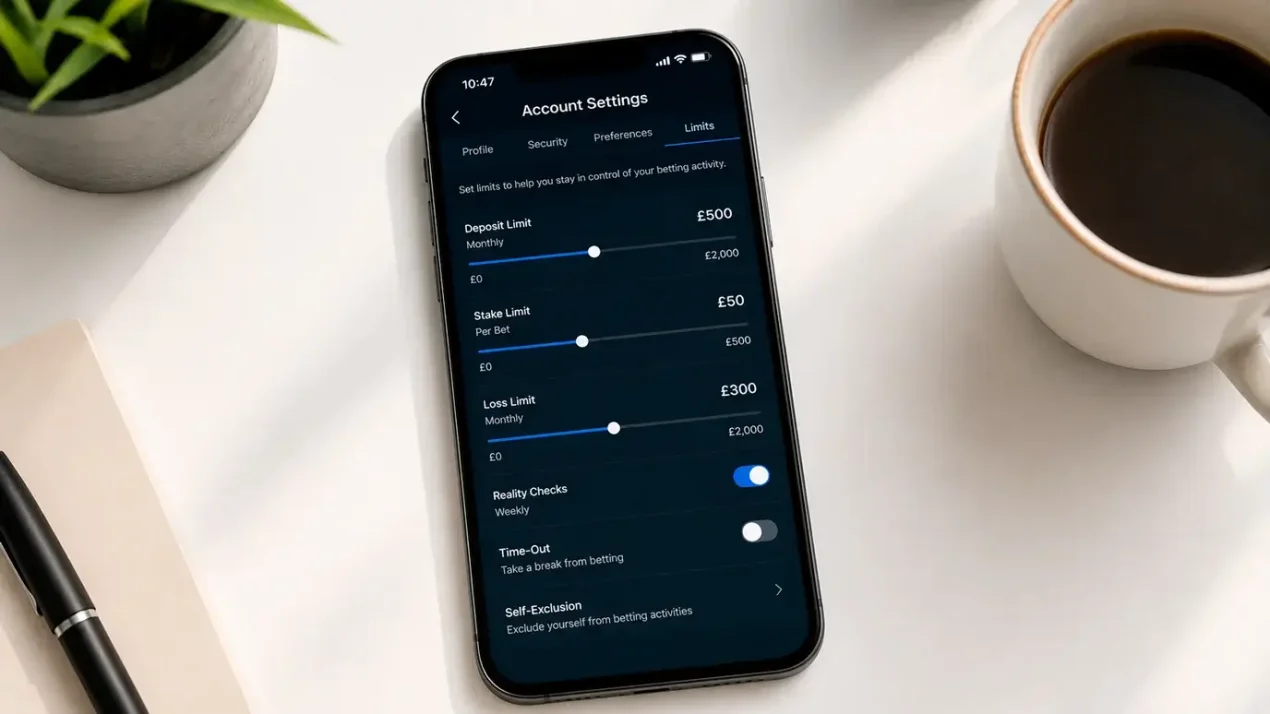
The UK Gambling Commission’s data paints a sober picture. Approximately 2.7% of the adult population meets the criteria for serious problem gambling, and only 3.4% of those individuals seek help. That gap — between the scale of the problem and the rate of intervention — is the reason every UKGC-licensed bookmaker is required to provide a suite of responsible gambling tools. These are not optional add-ons. They are regulatory mandates, and they exist because the industry’s own data shows they are necessary.
Setting Deposit Limits and Reality Checks for NBA Wagering
Deposit limits are the most direct tool available. Every UKGC-licensed operator must allow you to set daily, weekly, and monthly deposit caps. Once you hit the limit, you cannot deposit more until the period resets. The key detail: reducing a deposit limit takes effect immediately, but increasing one has a mandatory cooling-off period of at least 24 hours. This asymmetry is deliberate. It protects you from raising your limit in the heat of a losing streak and depositing more than you planned.
I set my deposit limits on the day I open any new account, before I place a single bet. The amount is derived from my bankroll plan — if I have allocated two hundred pounds for the month, my monthly deposit limit is two hundred pounds. No exceptions. The limit becomes a structural boundary that does not depend on my willpower at 1am when an NBA fourth quarter is not going my way.
Session timers work differently. Some operators allow you to set an alert that fires after a specified period of continuous activity — say, one hour or two hours. The alert reminds you how long you have been logged in and typically shows your net position (profit or loss) for the session. It is a nudge, not a lock-out, but the research on gambling behaviour consistently shows that time distortion is one of the earliest signs of problematic play. Losing track of how long you have been betting is a warning signal, and session timers catch it before the damage compounds.
Reality checks are a broader version of the same concept. They pop up at intervals you define and display your account activity: deposits, withdrawals, bets placed, net result. Sixty percent of the gambling industry’s profits come from just 5% of customers — the segment most likely to be experiencing harm. Reality checks are designed to interrupt the autopilot state that drives that harm, forcing a moment of reflection before the next bet is placed.
Self-Exclusion and GAMSTOP: How They Work
Self-exclusion is the strongest tool available, and it is the one I hope you never need. GAMSTOP is the UK’s national self-exclusion scheme. When you register with GAMSTOP, you are excluded from all UKGC-licensed online gambling operators for a minimum period of six months, with options for one year or five years. The exclusion covers every licensed website and app — not just the ones where you have accounts. Operators are legally required to prevent GAMSTOP-registered individuals from opening new accounts or accessing existing ones.
Individual operator self-exclusion is also available if you want to restrict access to a specific platform without blocking yourself from all gambling. Each bookmaker must offer this option through their responsible gambling settings. The minimum exclusion period varies by operator but is typically six months. During the exclusion, the operator must close your account, return any balance, and remove you from all marketing communications.
The cooling-off period is a lighter alternative. Most operators allow you to take a break of 24 hours, 48 hours, one week, or one month. During a cooling-off period, your account is temporarily inaccessible but not closed. I have used this myself during particularly busy stretches of the NBA schedule when I noticed my bet frequency increasing beyond what my analysis supported. Taking a 48-hour break cost me nothing and broke the pattern before it became a problem.
Recognising Warning Signs Early
Dr. Nasir Naqvi, who directs the Gambling Disorders Clinic at Columbia University, has described the growth of legal sports betting as a looming public health concern. The warning signs he and other clinicians identify are not dramatic — they are subtle, gradual, and easy to rationalise. Betting more than you planned. Chasing losses with larger stakes. Feeling anxious or irritable when you cannot bet. Hiding your betting activity from people close to you. Borrowing money to fund bets. Any one of these in isolation might be a bad day. Two or more in combination, consistently, is a pattern.
I track my own behaviour as carefully as I track my bets. If my unit size creeps above my predefined level, I stop and ask why. If I find myself placing bets without doing the research I normally do, I take a cooling-off period. If betting starts feeling like something I need to do rather than something I choose to do, that distinction matters enormously. Entertainment is voluntary. Compulsion is not.
The bankroll management framework I use is a first layer of defence, but it is not a substitute for the tools that operators are required to provide. Deposit limits, session timers, and self-exclusion exist because self-discipline alone is not always sufficient. Using them is not a sign of weakness. It is an acknowledgement that the product is designed to be engaging, and that engagement needs boundaries to remain healthy.
If you or someone you know is experiencing gambling-related harm, the National Gambling Helpline is available on 0808 8020 133, and GamCare provides free counselling and support services.
How does GAMSTOP self-exclusion work for NBA bettors?
GAMSTOP is the UK’s free national self-exclusion scheme. When you register, you are blocked from all UKGC-licensed online gambling sites and apps for a minimum of six months, with options for one year or five years. The exclusion applies across all operators, not just the ones where you have accounts. You can register at gamstop.co.uk.
What percentage of UK gamblers experience problems?
Approximately 2.7% of UK adults meet the criteria for serious problem gambling. Only 3.4% of those individuals seek help. These figures come from the UK Gambling Commission’s Gambling Survey for Great Britain, which tracks gambling behaviour and harm across the adult population.
This material was created by the COURTSIDE team.
Related posts
The Under-30 Surge Driving NBA Betting in Britain

Why 76% of Young UK Bettors Already Bet on Mobile